

THE US$62 TO US$800 PROBLEM: VALUING DEEP TECH AFTER SPACEX
Twenty-eight analysts publish a 12-month price target on Space Exploration Technologies Corp (SpaceX). The lowest- US$62 and the highest- US$800. Both figures were produced by professionals working from the same prospectus, the same segment disclosures and the same second-quarter results.
In most listed-company work, a thirteen-fold range between the bull and the bear would make you suspect somebody had dropped a decimal. That gap between the asset and the assumption is the whole of deep tech valuation, and it deserves closer examination than being written off as market noise.
What the Accounts Actually Say
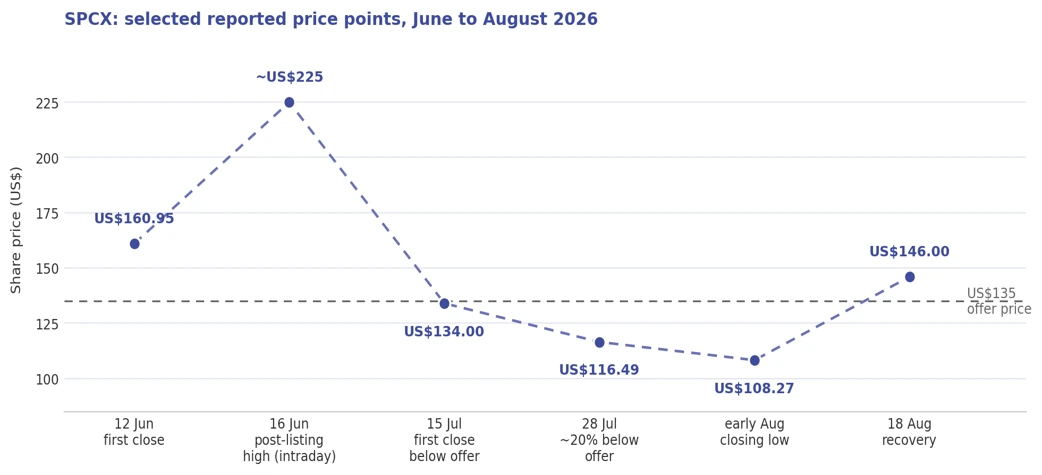
SpaceX listed on the Nasdaq on 12 June 2026 at US$135 a share and raised US$75 billion, the largest initial public offering ever completed. Saudi Aramco’s 2019 record of roughly US$29 billion was not close. The stock closed its first session at US$160.95, ran to about US$225 intraday by 16 June and for a few days the company was worth more than Microsoft.
Then it went the other way. By 28 July it had traded a fifth below its offer price, with Bloomberg putting the fall from the June high at more than US$1.2 trillion. It has since climbed back to around US$146. Nothing broke in between. No launch failed. No material contract was cancelled, and no restatement was filed. Ten weeks, no real news, and the market revised its view by more than a trillion dollars.
The S-1 landed on 20 May and, for anyone who had spent a decade guessing SpaceX’s economics, it made for a good afternoon. Consolidated revenue of US$18.7 billion for 2025, up from about US$14.1 billion. A loss from operations of US$2.6 billion. Adjusted EBITDA of US$6.6 billion, net loss of US$4.9 billion, accumulated deficit of US$41.3 billion and long-term debt of roughly US$29 billion.
Put the offer price against that. US$1.75 trillion of implied equity on US$18.7 billion of revenue works out at about 94 times sales; at the June high it was nearer 139 times. Mature listed satellite and launch businesses generally trade in the low single digits on the same measure. 94x is not a price for the company that filed those accounts. It is a price for a company somebody expects to exist in the 2030s.
Three Businesses Reported as One
The segment disclosure is where the valuation question actually sits. In 2025 the Connectivity segment, essentially Starlink, produced revenue of US$11.4 billion, about 61% of the group, and operating income of US$4.4 billion. The Space segment, covering the launch business, generated US$4.1 billion of revenue and an operating loss of US$657 million after absorbing around US$3.0 billion of Starship research. The AI segment booked US$3.2 billion of revenue against an operating loss of US$6.4 billion.
These are three different businesses with three different risk profiles and a single enterprise multiple applied across the consolidated entity conveys very little. One is a subscription utility with recurring revenue and improving margins. One is capital-intensive infra-structure carrying development cost it may never fully recover through third-party launches. One is an option on a technology whose unit economics are still being discovered. In a valuation of this kind, a sum-of-the-parts approach is not a refinement. It is the minimum acceptable work to be able to provide any meaningful analysis.
Contracted is Not the Same as Committed
One disclosure is worth reading twice. Ahead of the listing, SpaceX disclosed that Anthropic would pay approximately US$1.25 billion a month through to May 2029 for capacity across its Colossus data centres. Annualised, that is close to US$15 billion, set against an AI segment that earned US$3.2 billion in the whole of 2025. Fine print – either party can terminate on 90 days’ notice after an initial three-month period.
The pattern turns up in far smaller valuations: a headline contract value in the information memorandum, the termination clause three schedules further back, and a forecast built on the first without any reference to the second. Both figures are true. One of them is a commitment that renews quarterly. A model that treats them as the same input has an error in it, not a view.
The same question applies to Starlink. Subscribers have quadrupled since 2023 while average revenue per user has fallen over that period. A volume story and a pricing story running in opposite directions, and only one of them usually survives into the terminal value.
What the Dispersion is Telling Us
Which returns us to US$62 and US$800. Consensus sits around US$227. Morgan Stanley published US$300. UBS reiterated a Buy at US$210. Morningstar had called the stock overvalued before it listed, on the view that earnings would need decades to grow into the price. By 18 August the shares were near US$146 and the market value a little above US$1.9 trillion, helped by second-quarter revenue of US$7.8 billion that beat expectations.
None of those analysts is being careless. They are disagreeing about a decade none of them can observe. Once the bulk of present value sits beyond the explicit forecast, a discounted cash flow has quietly stopped being a forecast and become an argument about the 2030s with a cash flow schedule attached. Investors are entitled to hear that in those words, before they are shown the figures.
| Date | Milestone | Share price | Approx. market value |
|---|---|---|---|
| 12 June 2026 | Nasdaq debut; US$75 billion raised | US$135 offer; US$160.95 close | ~US$1.75 trillion at the offer price |
| 16 June 2026 | Post-listing high | ~US$225 intraday | ~US$2.6 trillion |
| 15 July 2026 | First close below the offer price | ~US$134 | ~US$1.75 trillion |
| 28 July 2026 | Traded around 20% below the offer price intraday | US$116.49 close | ~US$1.2 trillion below the June high |
| Early Aug 2026 | All-time closing low following Q2 results | US$108.27 | — |
| 18 August 2026 | Recovery after earnings and first lock-up expiry | ~US$146 | ~US$1.9 trillion |
Why Any of this Matters in SEA
Nobody in this region is pricing a trillion-dollar listing. We are, however, building the same category of asset, and the valuation problem does not scale down with the deal size.
DealStreetAsia’s Southeast Asia Deep Tech Review: 2025 counted 109 deep tech venture deals across the region last year, down from 117. The sector’s share of total venture-backed deal volume moved the other way, rising to 23.6% from 18.5%. Early-stage rounds accounted for 94.5% of that volume. Late-stage activity remains limited at six deals worth US$343 million, roughly a third of all deep tech capital raised. Across the wider regional market, startups took US$5.37 billion across 461 equity deals.
Fewer cheques, larger cheques, and far more scrutiny attached to each one. Malaysia’s semiconductor and advanced packaging base, and the China+1 reallocation sitting behind it, is producing precisely the kind of company this article is about: science-led, capital-hungry, no clean listed comparable, no earnings history to anchor a valuation multiple. Those valuations are being agreed in private rounds right now, and every one of them will eventually be tested at exit. SpaceX received its verdict in ten weeks. A founder in Penang may wait seven years for the verdict, which makes the discipline easier to defer.
Working Practice
A few things hold up across these valuations. Value the scenarios rather than the plan, and where a technical or regulatory milestone is genuinely binary, weight it and show the weights; a probability-weighted expected return is easier to defend than a single optimistic case discounted at a rate chosen to make the answer feel prudent.
Separate the funded plan from the ambition, and admit only capital you can provide evidence for. State the proportion of your discounted cash flow that sits in the terminal value, and if it is 92%, write 92%.
Read the constitution as closely as the accounts. Elon Musk holds about 85% of the voting power through Class B shares, and concentrated control of that order is a value factor. Where a minority interest is being valued it warrants a discount, not in a caveat at the back of the report.
Run a market approach even when the comparables are not ideal, and write down why they are not ideal. A weak/ not ideal comparable, honestly labelled, is worth more to a reader than no comparable at all.
Conclusion
The difficulty with deep technology is not that the figures are uncertain. Every valuation is uncertain. It is that the uncertainty concentrates in exactly the spot where a discounted cash flow is weakest, and the temptation at that point is to stop doing deeper and robust analysis and try to price the story and hype.
SpaceX’s first ten weeks are an expensive demonstration of what that costs. For boards here preparing to raise, list or sell something science-led, the work is unglamorous: evidence a third party can test, and an honest range stated at the front rather than discovered at the back. The range exists whether or not you publish it. Better that it turns up in your disclosure than in your share price.
Source:
- Space Exploration Technologies Corp., Form S-1 Registration Statement, filed with the US Securities and Exchange Commission, 20 May 2026.
- “SpaceX’s IPO Filing Gives First Look Into Company’s Financials”, Via Satellite, 20 May 2026.
- SpaceX company profile (revenue, valuation and funding), Sacra, accessed August 2026.
- SPCX share price, analyst estimates and price targets, Investing.com and Robinhood, accessed 18 August 2026.
- Southeast Asia Deep Tech Review: 2025, DealStreetAsia DATA VANTAGE, June 2026.
- Southeast Asia Startup Funding Report: Full Year 2025, DealStreetAsia and Kickstart Ventures, February 2026.
- “Deep tech takes larger share of SE Asia venture market despite wider funding crunch”, DealStreetAsia, 18 June 2026.
Business valuation is the process of determining the economic worth of a company through financial analysis, market comparisons and asset assessments. It is essential for M&A transactions, fundraising, legal disputes, succession planning, financial reporting and strategic decision-making.
Key triggers include selling or acquiring a business, raising capital from investors, settling shareholder disputes, complying with regulatory requirements, planning an IPO, restructuring debt, or conducting annual financial reviews.
The three primary approaches are: the Income Approach (Discounted Cash Flow), the Market Approach (comparable company analysis and precedent transactions), and the Asset-Based Approach (net asset value). The most appropriate method depends on the nature and stage of the business.
A standard valuation engagement takes between 2 to 6 weeks, depending on the complexity of the business, the availability of financial data and the purpose. Complex or contested valuations may take longer.
Valuers typically require audited financial statements (3–5 years), management accounts, business plans, a list of assets and liabilities, shareholder agreements, key contracts and relevant industry or market data. Exact requirements vary by engagement.
Book value is the net asset value recorded on a company's balance sheet. Market value reflects what a willing buyer would pay a willing seller in an arm's-length transaction — often significantly different due to goodwill, intangibles and market sentiment.
IP valuation employs cost-based, market-based and income-based approaches. The Relief-from-Royalty Method is widely used for patents and trademarks, while the Multi-Period Excess Earnings Method is common for customer relationships and proprietary technologies.
Certified valuers adhere to international valuation standards (IVS, RICS, NACVA), produce defensible reports accepted by courts, regulators and investors, and provide objective, independent analysis free from conflicts of interest.
